Recap of Senior Year Projects
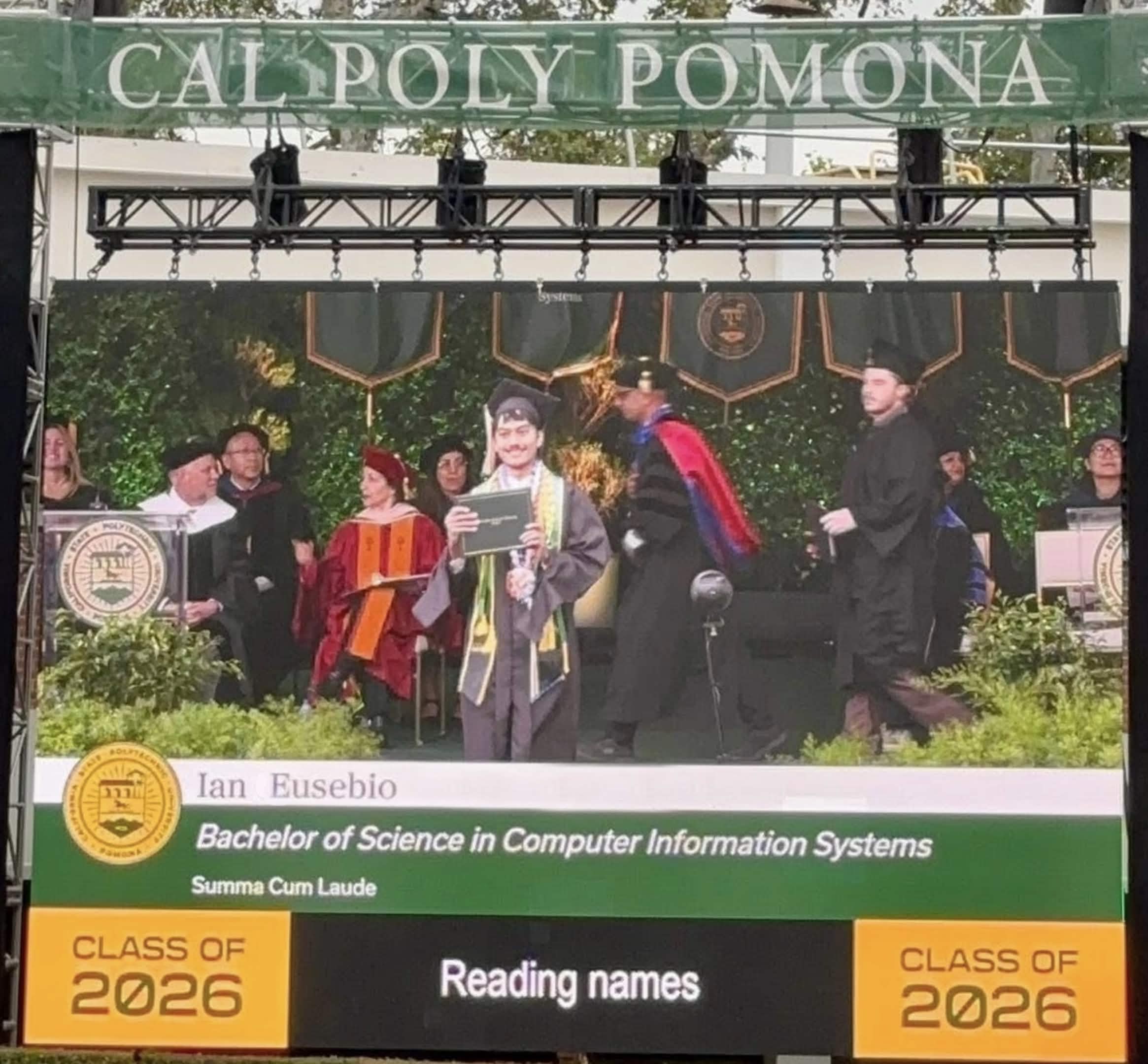
Hello blog, it’s been a while since I’ve posted, but I promise I have been active. This past school year has been my senior year at Cal Poly Pomona, so I’ve been trying to gain as much experience as I can. Earlier this month, I received my Bachelor’s of Science in Computer Information Systems from Cal Poly Pomona as well as my Network+ certification.
There were lots of great projects I had the opportunity to be a part of, so I thought I’d make a list to compile them all.
1. CCDC Windows Security Team Member and Devving (Fall-Spring)
Last summer, I tried out for the Cal Poly Pomona CCDC (Collegiate Cyber Defense Competition) team and landed a spot on the team as a secondary Windows team member. We sadly did not make it to regionals, but I am grateful for the experience to compete. I was able to meet other dedicated cybersecurity students and gain more practice with PowerShell, firewall rules, networking concepts, and hardening techniques against an active red team.
As part of the competition, our team was also able to design our own environment for an invitational. Using draw.io, I made the network diagram for the environment and worked on some of the Windows machines. The theme was an AI therapy company and all the virtual machines were named after Greek gods or parts of the brain.
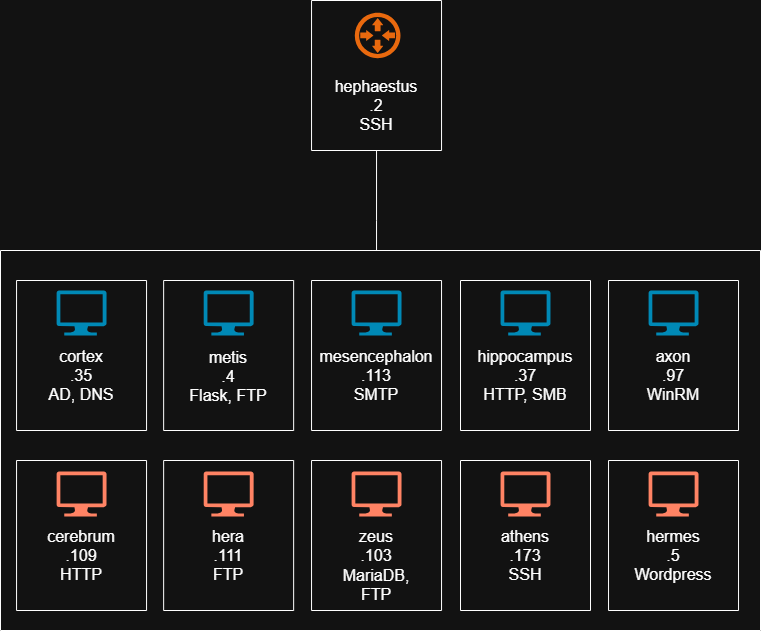
For example, hephasetus was the router, the .2 denoted the last octet of its IP address, and SSH was the scored service on that box. This diagram intentionally did not display the interdependencies between boxes because a large part of the competition is learning how all the different services are connected and how to remedy their security vulnerabilities. (Hint: Many services are typically reliant on databases)
This environment is available to download here if you’d like to test it out for yourself.
2. LEAP - Project Coordinator Fellow (Fall-Spring)
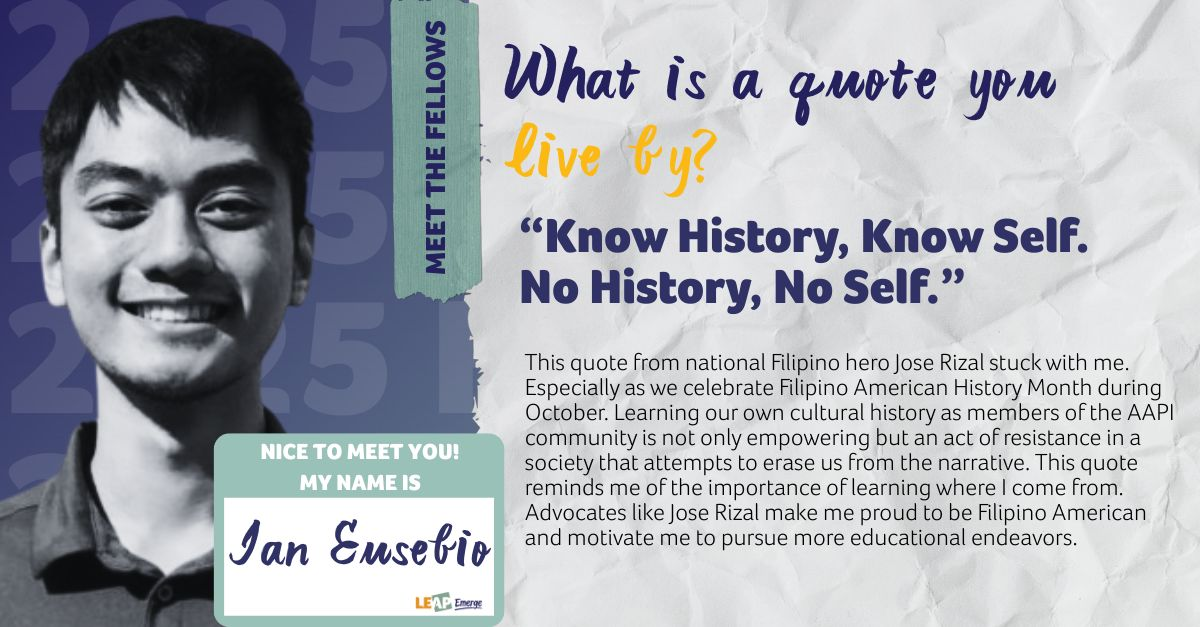
LEAP (Leadership Education for Asian Pacifics) is another program I was part of. While it was not an outright technical fellowship, I found their career development sessions valuable. We were also assigned a community impact project to complete as part of the program. Our project was a video interview series that focused on addressing the bamboo ceiling, which refers to the systemic barriers that Asian American Pacific Islander professionals face when advancing in their careers. I served as one of the Project Coordinator Fellows where I organized communications between the different teams of the project, such as the interviewers, finance team, and the LEAP staff members to ensure the project stayed on track.
3. SWIFT Competitions Officer (Fall-Spring)

Outside of that CCDC invitational, I also helped build competitions for SWIFT (Students With an Interest In the Future of Technology), one of the cybersecurity clubs at Cal Poly Pomona. My last post was on SCARE in October, a Halloween themed pen-testing Capture-The-Flag competition!
Similar to CCDC, I mainly developed the Windows boxes, so I had to intentionally add security vulnerabilities for competitors to either defend against or exploit, depending on the type of competition. These vulnerabilities ranged from more simple ones, such as having accounts that are easily password cracked, anonymous log-ins enabled, web shells, and weak policies on remote access services (RDP, SSH), to more complex ones like ESC attacks.
4. STORM CyberAI Research Symposium (January)
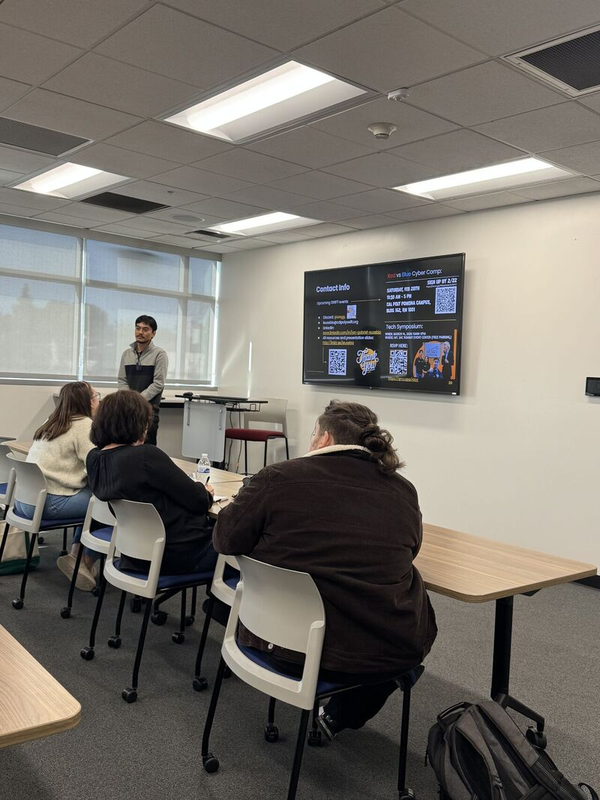
If you’re curious about cyber competitions, I made a presentation with an overview of them for a conference. As a member of the STORM (Security Technology Operations Research Monitoring) cybersecurity career development program at Coastline College, I had the opportunity to present at their research symposium.
I mainly went over the different types of cybersecurity competitions (defense, offense, Capture-The-Flag style) as well as some national level competitions and the in-house competitions we host through SWIFT at Cal Poly Pomona. Sharing my experiences in both competing and designing cyber competitions was great.
Learning new concepts in cybersecurity can be intimidating, so I try my best to familiarize people who are newer. I enjoy sharing resources and knowledge about different technologies with others to make it easier for them. Presenting at the STORM symposium reaffirmed my passion in education and using technology to help others. 🙂
5. SCALE (March)
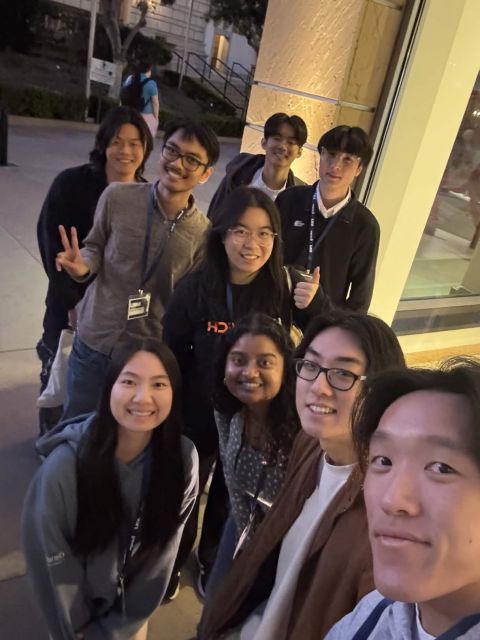
Speaking of education, I was able to attend SCALE (Southern California Linux Expo) a few months ago with some of my CCDC teammates and their mentees. My favorite talk was from a professor who spoke about his challenges and successes with integrating open source technology in his curriculum.
He also talked about how at one point, hackers were selling his students’ data on the dark web, yet no one wanted to buy it because community college student info is not in demand lol. Many of his students were worried about job security with the rise of AI, which is a difficult issue to tackle on top of the additional struggles they faced as community college students. As a community college transfer myself, it was validating to hear him acknowledge those topics. Understandably, he did not have all the answers and instead focused on educating as best he could to prepare his students for the future of the workforce.
Something fun he brought up was how some of his students built databases for things like Minecraft recipes or keeping track of dog breeds as part of their class projects. I found his talk to be very inspiring, and it gave me ideas on different ways to incorporate open source software as an educational tool. Overall, I appreciated how this conference highlighted free and easily available technology.
6. Insecure Deserialization in Ren’Py (April)
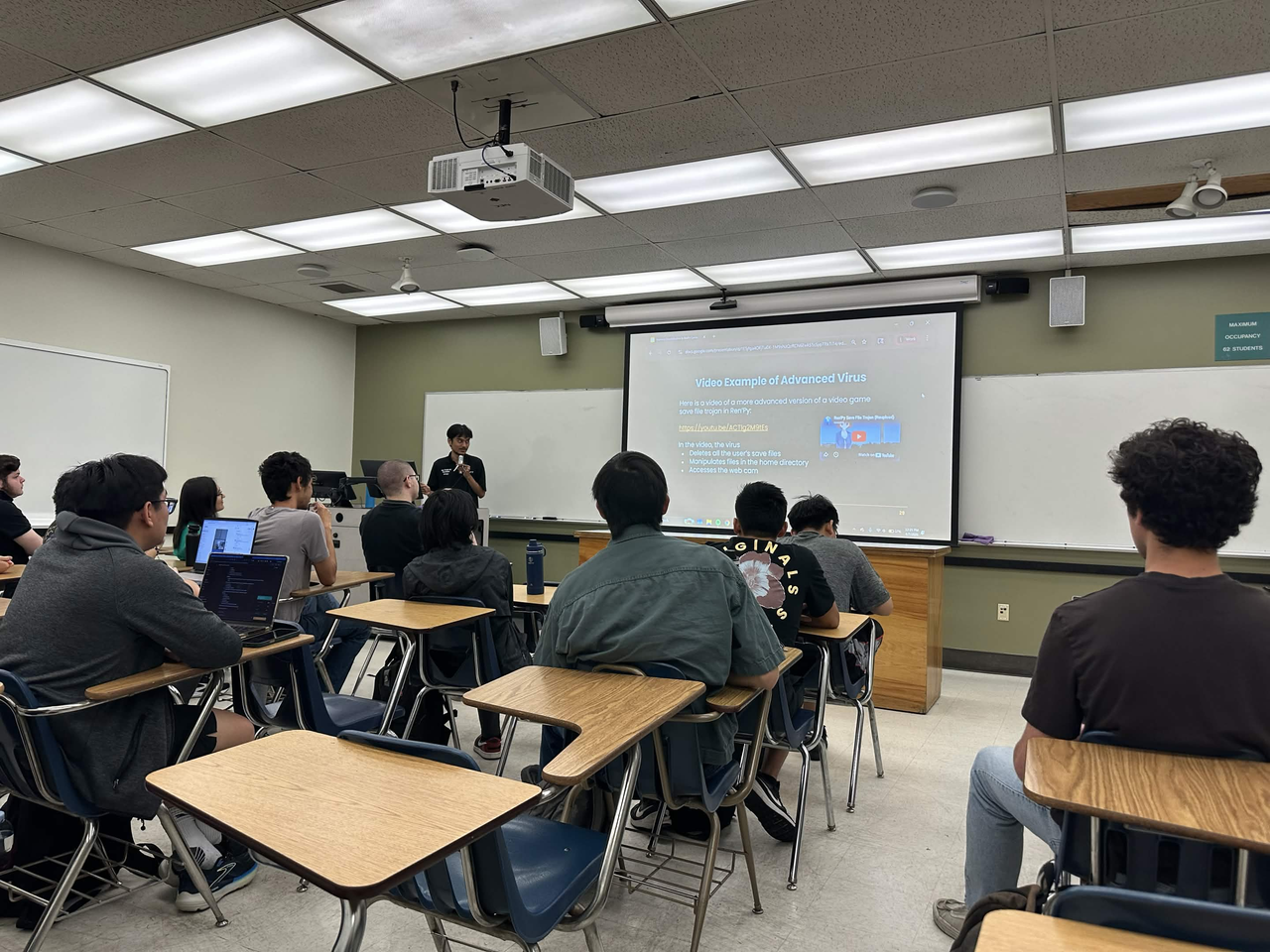
In addition to being a Competitions Officer with SWIFT, I was also assigned a SWintern (SWIFT intern) project. SWinterns assist the executive board and get to present on a cybersecurity topic of their choice. I chose to present on insecure deserialization in Ren’Py.
Serialization is the process of turning an object into a byte stream to make it easier to store or transmit. Deserialization is the reverse of that process, which turns the byte stream back into the original object. However, insecure deserialization occurs when attackers are able to run arbitrary code to a deserializer (OWASP entry).
Ren’Py, a text-based video game engine, uses this process to store its save files through the Python Pickle library. User swoops on GitHub was able to figure out a way to use insecure deserialization to insert trojan viruses that disguised themselves Ren’Py save files.
I showcased this topic at a Game Development Club meeting at Cal Poly Pomona so it could also be a collaboration event with SWIFT! It was fun to bridge the two clubs together through the overlap between cybersecurity and game development.
7. Network Anomaly Detector - AI Fair (April)
My last project with SWIFT was tabling at our school’s AI Fair. This project involved another intersection between two fields, but this time it was cybersecurity and machine learning (ML). I found a GitHub repository that used machine learning algorithms to analyze network traffic and detect anomalies. As a bonus, the repository is able to be self-hosted. You can even upload your own CSV files of network traffic.
Anomaly detection is a subfield of AI and machine learning that involves finding any data that is “out of the ordinary”. For example, anomaly detection is used in finance to flag possibly fraudulent transactions. In the context of this project, the repo uses this concept to find suspicious network traffic, like unusual port usage or large data transfers. We made a flyer below to explain and visualize how the 3 ML algorithms Isolation Forest, Local Outlier Factor, and One-Class SVM are used to detect anomalies.
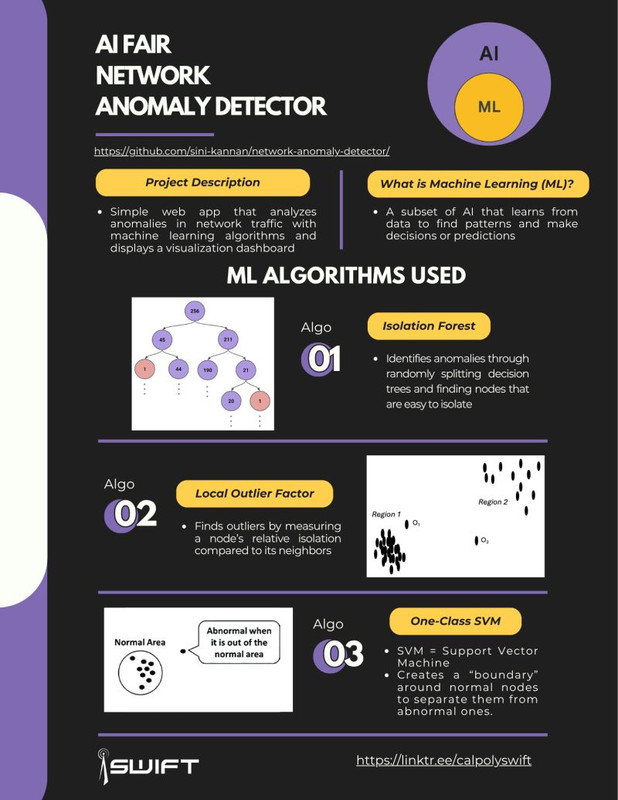
In collaboration with my fellow Competitions Officer Alex, we forked the repository to include our custom network traffic CSV file for the ML algorithms to analyze. View the forked repository here.
Reflection and Thank You’s
This was quite the final school year. I was so anxious about what post-grad would look like for me, but I’m learning to take it day-by-day. Fortunately, I have found work as a computer technician for a Department of Rehabilitation IT vendor. Despite my undergrad ending, I will still be taking cyber classes with STORM and continue looking for more learning opportunities. My goals remain the same: I want to keep finding ways to use computers as a tool to support others and provide resources, but I understand that I may need to get a bit creative about it during these times.
I am so incredibly thankful to everyone that has supported me through this journey. Earning a bachelor’s degree is a huge undertaking and I would not have been able to do it without the encouragement of these communities and individuals:
- Slava for encouraging me to start this blog
- Jeff
- Dylan
- Judy
- Amara
- SWIFT
- CCDC Team
- STORM and Dr. West
- LEAP and all my LEAP mentors
- Miramar College Career Center and Outreach departments
- Cherrie and the CPP Career Center Team
- APO
- Horse Library
- Gomeez Homies
- Eusebros
Thank you for checking out my blog and reading about all my senior year projects. Feel free to connect with me either here or on LinkedIn where I originally shared most of these projects. I love hearing from other computer/education enthusiasts.